(4+6+8+...+2n-4)+(4+6+...+2n-6)+...+4 = (n^3 - 3n^2 - 4n + 12)/3. n >= 4
.
Here's the first one:
\(f\left( x\right)=2+x^3(7\ln(x)-9) \\ \\ f'(x)=3x^2(7\ln(x)-9)+\frac{7x^3}{x}\rightarrow x^2(21\ln(x)-20) \\ \\ f'(1)=1^2(21\ln(1)-20)\rightarrow -20 \\ \)
"Why does 0.999 equal 1."
As written it doesn't! However, if you mean the 9's go on forever then:
Let x = 0.999999...... etc.
10x = 9.999999..... etc.
Subtract the first from the second to get: 9x = 9 or x = 1
If your equations are:
2y = x + 2 (1)
x - 3y = -5 (2)
Then:
Rearrange (2) to get: x = -5 + 3y (3)
Replace x in (1) using (3): 2y = -5 + 3y + 2
Rearrange: -y = -3 so y = 3
Put this into (3): x = -5 +3*3 so x = 4
(x, y) = (4, 3)
N5 + N8 = 30000
0.08*N8 - 0.05*N5 = 840. Replace N8 using the above:
0.08*(30000 - N5) - 0.05*N5 = 840
0.13*N5 = 30000 - 840
N5 = (30000 - 849)/0.13
N5 = $12000
I think you forgot a 5x^2 in your subtraction Max!
Here's an alternative approach:
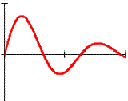
Here's a graph:

 +33669

