My friend plays Osu
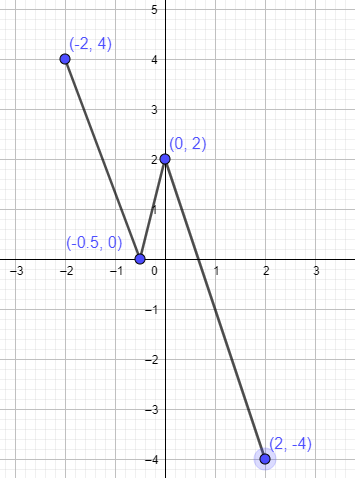
Here's part (b)
It's the graph of f(2x)
Now....all you have to do for part (d) is to shift this graph over to the right by 8 units and connect the dots
Each point shown will have 8 added to its x coordinate and y will not change
Let me know if you have trouble with this
My classroom has 11 rows of chairs, with 11 chairs in each row. The chairs in each row are numbered from 1 to 11. How many chairs have odd numbers?
We have 11 * 11 = 121 chairs
So....the number of "odd" ones = 120/2 + 1 = 60 + 1 = 61
Well, there are 121 chairs numbered from 1-121. We know that every other number is an odd number.
Can you take it from here?
Thanks, Cal !!!!
Those are going to involve drawing graphs......this is a little time-consuming....I'll see if I can do this in a little while, because I have other questions to answer.....sorry!!!
Check this out:
https://www.chegg.com/homework-help/questions-and-answers/golf-course-designers-become-concerned-old-courses-becoming-obsolete-since-new-technology--q5276344
https://smart-answers.com/mathematics/question13027733
In right triangle ABD, AD = sqrt [ BD^2 - BA^2] = sqrt [ 15^2 - 12^2] =sqrt [ 225 -144] = sqrt [81 = 9
So...its area = (1/2)product of the legs =(1/2) BA * AD = (1/2)12 * 9 = 54
And in right triangle BDC, DC = sqrt [ BC^2 - BD^2] = sqrt [ 17^2 - 15^2] = sqrt [ 289 - 225] = sqrt [ 64] = 8
So....the area of triangle BDC =(1/2) (8)(15) = (1/2) (120) = 60
So....the area of ABCD = 54 + 60 = 114
Also...
The same question was posted here as well: https://web2.0calc.com/questions/help-me-asap-please_2#r2
What about parts b and d?
(c) f(2x - 8) just takes the points that we found in (a) and shifts them to the RIGHT by 8 units
So
(-2,4) becomes (-2 + 8, 4) = (6,4) so c = 6
And
(2, -4) becomes ( 2 + 8, -4) = (10, -4) so d = 10
Thanks
I know a couple of these
(a) f(2x) makes the graph 1/2 as wide as the original
So note that the points (4, -4) and (-4, 4) are on the original graph
So ( a, 4) on f(2x) gives us ( -2, 4) so a = -2
And (b, -4) on f(2x) gives us (2, -4) so b = 2
Note that DG is just the hypotenuse of a right triangle with legs DO and OG
So...its length = sqrt [ DO^2 + OG^2 ] = sqrt [ 24^2 + 10^2] = sqrt [576 + 100] = sqrt [ 676] = 26
1.2n - 4.4 < 5.2 add 4.4 to both sides
1.2n < 9.6 divide both sides by 1.2
n < 8
So.....the positive integers hat satisfy this are
1,2,3,4,5,6,7
And their sum = (7)(8) / 2 = 56 / 2 = 28
Sorry for messing up. I shoulda caught my mistake. But now it's fixed. Thanks in advance for answering it!!
Note that the altitude of the right triangle on the left = sqrt (5^2 -1^2)= sqrt (25 -1) = sqrt (24)
And ? is the hypotenuse of the right triangle o the right with legs of sqrt (24) and 5
? = sqrt [ 5^2 + (sqrt (24))^2 ] = sqrt [ 25 + 24 ] = sqrt [49] = 7
Right triangle ACD is a 5 -12 -13 Pythagorean Triple
So AD = 12
Since AB = 15.....then BD =sqrt [ AB^2 - AD^2] = sqrt ( 15^2 - 12^2 ] = sqrt [225 - 144] = sqrt [81] = 9
So....the area of triangle ADB = (1/2)(BD)(AD) = (1/2)(9)(12) = 54 (1)
And the area of triangle ACD = (1/2)(5)(12) = 30 (2)
So the area of triangle ACB = (1) - (2) = 54 - 30 = 24
\(\frac{1}{3}<{\frac{x}{5}}<{\frac{5}{8}} \)
Take this by parts
1/3 < x/5 cross-multiply x/5 < 5/8
5 < 3x divide both sides by 3 8x < 5 * 5
5/3 < x 8x < 25 divide both sides by 8
x > 5/3 x < 25/8
So the solution is
5/3 < x < 25/8
I edited it. now it should be there.
-PharoaCarl
Sorry I almost forgot to put in the questions. Dumb me






 . I shoulda caught my mistake. But now it's fixed. Thanks in advance for answering it!!


