Hi, I hope this sketch helps:
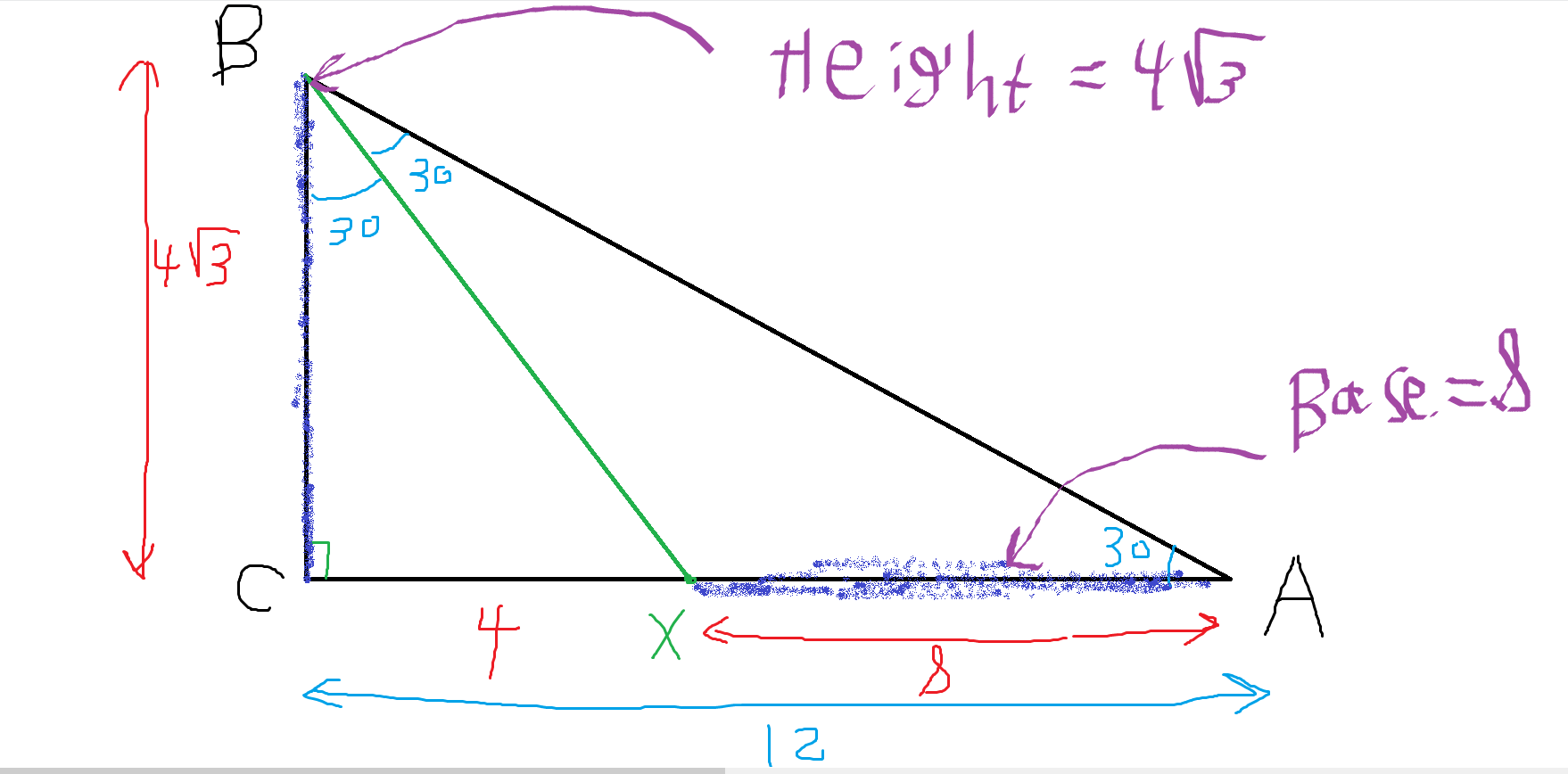
Steps:
Ignore anything in red for now, we are going to find it.
But first, we need to identify what we really want.
We want the area of Triangle BXA. To find the area of a triangle, it must have a base and a height.
The height is BC (The height is defined to be a vertical line connected the top most point of a triangle to the lower most point).
And the base (I.e. the side where the height is perpendicular on it) is AX.
Thus, the desired area is just: \(\dfrac{1}{2}*AX*BC\).
Now, we need to find both of BC and AX.
Firstly, for triangle ABC: we have AC = 12 and angle B is 60.
So using trigonometry: \(\tan(60)=\dfrac{12}{BC} \implies BC=4\sqrt{3}\)
(Note: If trigonometry is not allowed, then you have to remember the ratios in the 30-60-90 triangle).
So we have found BC.
Next, consider triangle BXC:
Again, using trigonometry to find XC:
\(tan(30)=\dfrac{XC}{4\sqrt{3}}\implies XC=4\)
But we want AX not XC. Thus, \(AX=12-4=8\)
Thus the area of the triangle is: \(\dfrac{1}{2}*8*4\sqrt{3}=16\sqrt{3}\)
I hope this helps!



