+113
+113 I think it is 13. In an Arithmetic Sequence the difference between one term and the next is a constant.
So if we imagine the first number is 1 and then the third is 9, we have these three numbers 1, 5, 9...
We see that there is a jump of 4 every time, so the sequence becomes...
1, 5, 9, 13, 17, 21 ....
See: https://www.mathsisfun.com/algebra/sequences-sums-arithmetic.html
+113 This is probably pre vector algebra or something.
Let's call these vertices A(1,6), B(1,11) and C(7,43).
We can find the length of each of the sides using the pythagorean theorem.
AB = (0,5), length = 5
AC = (6,37), length = \(\sqrt{6^2 + 37^2} = \sqrt{1,405} \approx 37.48\)
BC = (6,32), length = \(\sqrt{6^2 + 32^2} = \sqrt{1,405} \approx 32.56\)
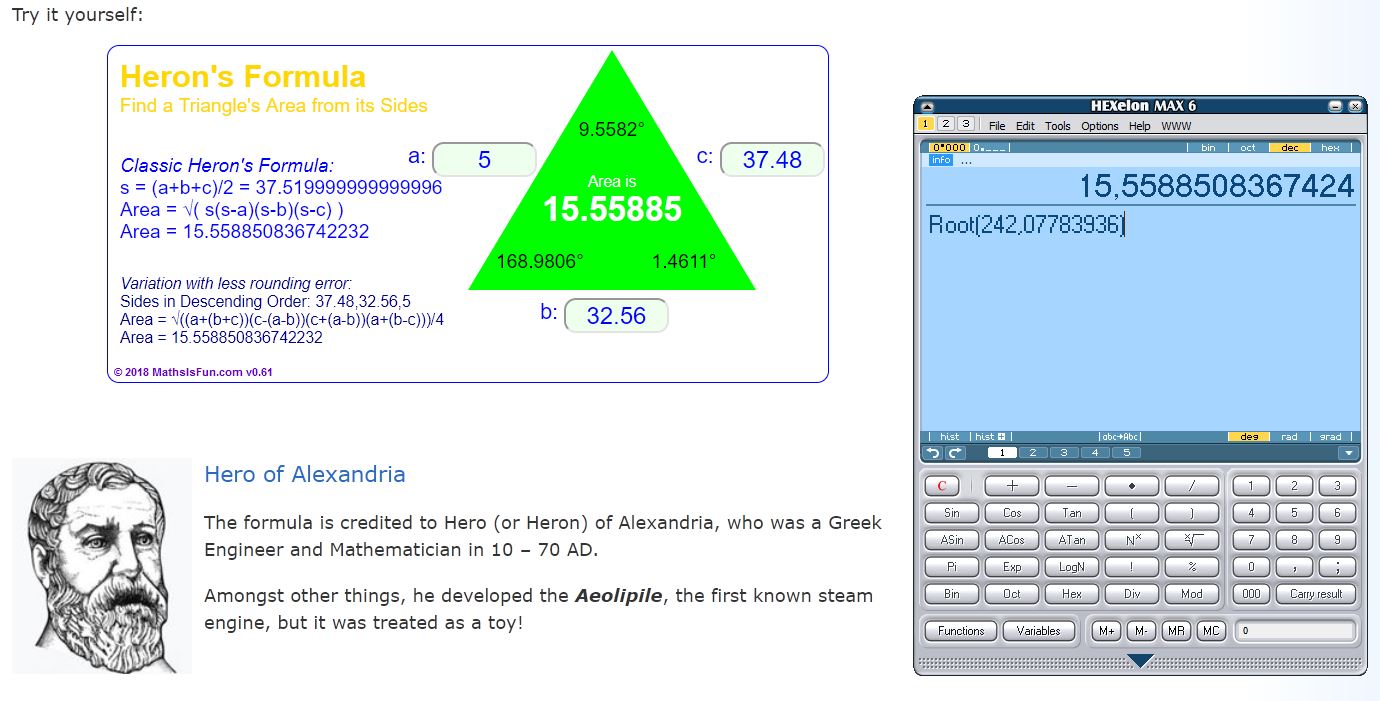
Use herons formula, see https://www.mathsisfun.com/geometry/herons-formula.html
s = 1/2 ( a + b + c ) = 1/2 ( 5 + 37.48 + 32.56 ) = 1/2 (75.04) = 37.52
The area is A = \(\sqrt{s\times(s-a)\times(s-b)\times(s-c)} = \sqrt{37.52\times32.52\times 0.04\times 4.96} = \sqrt{242.08} \approx15.56 \)
+113 +113 Find angle A = cos-1(2/3) = 48.19 (Deg), and angle B = cos-1(2/9) = 77.16 (Deg), so angle C = 180 - 48.19 - 77.16 = 54.65 (Deg).
The Sine Rule states that a/sin(A) = b/sin(B) = c/sin(C). We also know that a + b + c = 24.
Let's try and use both of these to express a and b by means of c.
a = c x (sin(A)) / sin(C) = c * 0.745 / 0.816 = 0.913 x c, b = c x (sin(B)) / sin(C) = c x 0.975 / 0.816 = 1.195 x c.
Substituting (exchanging) a and b for these gives us that: a + b + c = 24 is the same as 0.913 c + 1.195 c + c = 24,
or 3.108 c = 24. Divding on both sides gives us c = 24 / 3.108 = 7.722.
Now we can back-substitute and find a and b, a = 0.913c = 0.913 x 7.722 = 7.050, and b = 1.195c = 1.195 x 7.722 = 9.228.
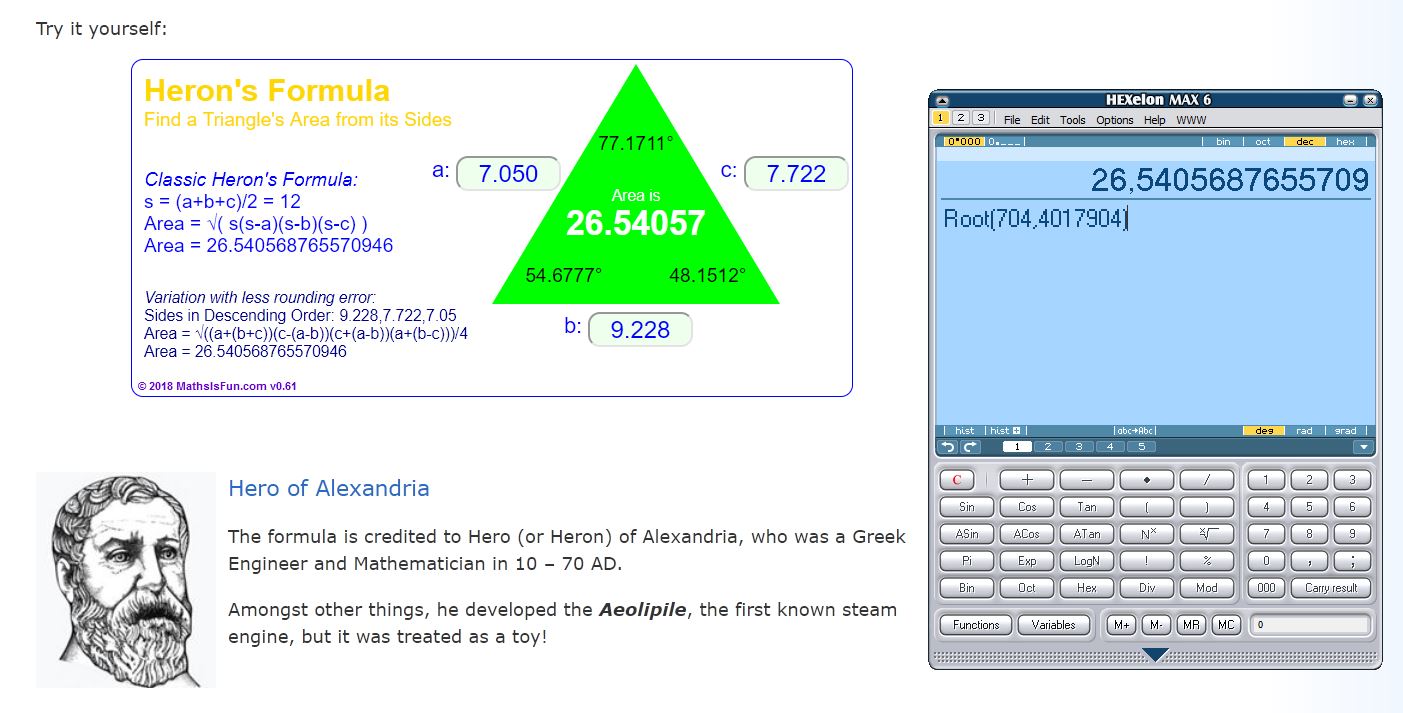
We can find the area of a trangle given all it's sides by using Heron's formula:
(Se: https://www.mathsisfun.com/geometry/herons-formula.html )
We find s = 1/2 x ( a + b + c ) = 1/2 (7.050 + 9.228 + 7.722) = 1/2 (24) = 12.
[This being a whole number indicates we are on the right path)
The area is given by \(A =\sqrt{s(s-a)(s-b)(s-c)}\) , so \(A =\sqrt{12\times4.59\times2.772\times4.278} = \sqrt{704.402} \approx 26.54\)
Hope this helps!