+9495
+9495 | Statement |
| Reason |
| ∠1, ∠2, ∠3, and ∠4 formed by two intersecting segments. |
| Given |
| ∠1 and ∠2 form a linear pair. |
| Definition of linear pair |
| ∠2 and ∠3 form a linear pair. |
| Definition of linear pair |
| m∠1 + m∠2 = 180° |
| Linear Pair Postulate |
| m∠2 + m∠3 = 180° |
| Linear Pair Postulate |
| m∠1 + m∠2 = m∠2 + m∠3 |
| Substitution Property of Equality |
| m∠1 = m∠3 |
| Subtraction Property of Equality |
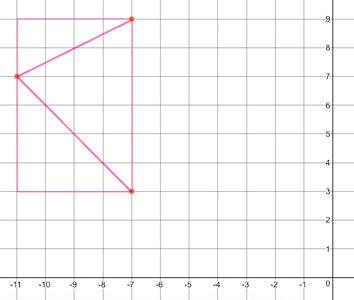
+9495 When you double the x coordinates, it changes the shape of the triangle. So
△JKL is not congruent to △J'K'L' because the rules do not represent a sequence of rigid motions.
Here's an example: https://www.desmos.com/calculator/lzqk0meoup
The x coordinate of the vertices on the green triangle are double those of the orange triangle.


 👋
👋